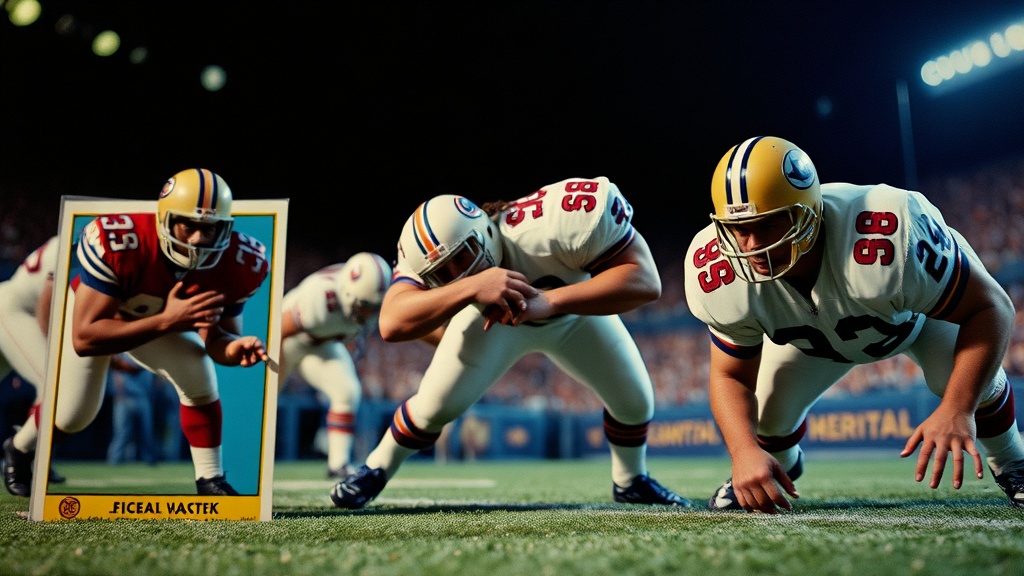
7 Legendary Football Cards Every Serious Collector Must Own

1958 Topps Jim Brown Rookie Card
2000 Playoff Contenders Tom Brady Autograph Rookie
1986 Topps Jerry Rice Rookie Card
1976 Topps Walter Payton Rookie Card
2017 Panini Prizm Patrick Mahomes Rookie
1981 Topps Joe Montana Rookie Card
1998 SP Authentic Peyton Manning Rookie Auto
What This Post Covers
Seven legendary football cards represent the absolute pinnacle of the hobby. Each one carries historical significance, rarity, and investment potential that separates serious collectors from casual enthusiasts. Whether building a legacy collection or hunting for the next grail card, understanding these seven pieces provides a roadmap for what truly matters in football card collecting.
What Is the Most Valuable Football Card Ever Sold?
The 2017 Patrick Mahomes National Treasures NFL Shield Rookie Auto holds the record. It fetched $4.3 million in a private sale through PWCC Marketplace in July 2021. That single transaction changed how collectors viewed modern cards forever.
Before Mahomes, the 2000 Tom Brady Playoff Contenders Championship Ticket dominated headlines. Brady's rookie autograph — limited to just 100 copies — consistently commands seven figures at auction. The card captures the beginning of the greatest quarterback career in NFL history.
Here's what makes these high-value cards special: population scarcity, historical context, and condition sensitivity. The Mahomes Shield features an actual piece of an NFL game-worn jersey — the shield patch from the Kansas City Chiefs uniform. That material connection to the field matters deeply to collectors.
"Condition is king in this hobby. A PSA 10 Brady Contenders sells for ten times what a PSA 9 brings."
The modern card market moves fast. What broke records yesterday might not tomorrow. That said, the Mahomes and Brady cards represent something timeless — the intersection of generational talent and limited supply.
1. 1957 Topps Johnny Unitas Rookie (#138)
The foundation of any serious vintage football collection starts here. Unitas revolutionized the quarterback position with the Baltimore Colts, and this horizontal-layout card captures him mid-throw in classic black and white.
Topps printed these cards on thin stock that didn't age well. Finding one in PSA 7 or higher proves genuinely difficult. Most surviving copies show creasing, gum stains, or centering issues — common problems with 1950s production.
The card's historical weight cannot be overstated. Unitas invented the two-minute drill. He won three NFL championships and a Super Bowl. For collectors who value football heritage, this rookie represents the beginning of modern quarterback play.
Values have climbed steadily. A PSA 8 Unitas rookie trades hands for $15,000–$20,000. PSA 5 examples — still presentable for most collections — run around $3,000. That's accessible for dedicated collectors willing to save.
2. 1986 Topps Jerry Rice Rookie (#161)
Widely considered the greatest wide receiver ever, Rice's rookie card comes from the iconic 1986 Topps football set. The design features that distinctive green and red border that instantly signals 1980s football to collectors.
Here's the thing about 1986 Topps — the print quality varied dramatically. Many Rice rookies suffer from print dots, off-center cuts, or wax stains from pack storage. A true gem mint copy (PSA 10) rarely surfaces. When one does, expect to pay $30,000 or more.
Rice's statistical dominance supports the card's value. His records for receptions, receiving yards, and touchdowns still stand decades after retirement. No receiver has come close — not Randy Moss, not Larry Fitzgerald, not anyone.
The 1986 Topps set also includes rookies of Reggie White, Steve Young, and Bruce Smith. It's arguably the most stacked football set of the decade. That context makes the Rice card even more desirable — it belongs to a legendary class.
Which Football Cards Have the Best Investment Potential in 2025?
Modern rookies of established superstars with limited supply offer the safest growth trajectory. Think Joe Burrow's 2020 Panini Prizm Black Finite 1/1 or Justin Herbert's National Treasures RPA — cards with single-digit print runs from premium products.
Vintage continues appreciating steadily. The 1958 Topps Jim Brown rookie consistently outperforms broader collectibles markets. Brown's cultural significance — transcending football as an actor and activist — adds layers of value beyond the gridiron.
| Card | Print Run | PSA 10 Population | Price Range (2024) |
|---|---|---|---|
| 1957 Topps Unitas Rookie | Unlimited | ~45 | $15,000–$50,000 |
| 1986 Topps Rice Rookie | Unlimited | ~70 | $8,000–$35,000 |
| 2000 Playoff Contenders Brady Auto | /100 | ~8 | $500,000–$3,000,000 |
| 2017 National Treasures Mahomes Shield | /25 | ~3 | $100,000–$4,300,000 |
| 2020 Prizm Burrow Black Finite | /1 | N/A | $50,000–$150,000 |
The comparison reveals a pattern: scarcity drives premium pricing. While vintage cards had unlimited print runs, survival rates create natural scarcity. Modern cards build scarcity into the design through numbered parallels.
For collectors building investment portfolios, diversification across eras makes sense. Vintage offers stability. Modern offers upside. The sweet spot? Late-1990s and early-2000s cards — the "junk wax recovery" era — where production dropped but quality improved.
3. 2000 Playoff Contenders Tom Brady Championship Ticket (#144)
No serious collection feels complete without acknowledging the Brady rookie. The Championship Ticket parallel — limited to 100 hand-numbered copies — represents the holy grail of modern football cards.
The standard Playoff Contenders Brady rookie numbered to 1,000 copies still commands $10,000+ in high grade. But the Championship Ticket? That's a different universe. Recent sales have ranged from $500,000 for PSA 8 copies to over $2 million for PSA 9 examples.
What separates this card is the on-card autograph. Brady signed these as a sixth-round draft pick — nobody knew what he'd become. The signature quality varies; some are rushed, others pristine. The best examples show full "Tom Brady" script with consistent ink flow.
Collectors seeking this card should verify the serial number matches the PSA certification. Counterfeits exist. Authentication through established grading services isn't optional — it's mandatory.
4. 1958 Topps Jim Brown Rookie (#62)
The greatest running back in NFL history — yes, better than Sanders, better than Payton, better than anyone — made his cardboard debut in this classic set. Brown's 1958 Topps rookie shows him in a Cleveland Browns uniform, ready to punish defenders.
Brown retired at age 30 while still dominating. He walked away from the game at his peak to pursue acting and activism. That decision — cutting short what could have been untouchable records — adds mystique to his collectibles.
The 1958 Topps design features team-colored borders that chip easily. High-grade Brown rookies command serious premiums. A PSA 8 sold for $358,000 in 2021. Even PSA 5 examples trade for $8,000–$12,000.
Worth noting: Brown's cultural impact extends beyond statistics. He founded the Black Economic Union and worked tirelessly for social justice. For collectors who value story alongside stats, no card delivers more.
How Do You Authenticate and Grade Vintage Football Cards?
Professional grading through PSA, SGC, or Beckett provides authentication and condition assessment. The process involves examining centering, corners, edges, and surface — the four pillars of card condition.
For vintage cards, grading serves dual purposes. First, authentication protects against the surprisingly common counterfeit market. Second, the numeric grade establishes fair market value. An ungraded 1957 Unitas might sell for $500. The same card in PSA 7 brings $8,000.
The catch? Grading costs money and time. PSA's economy service runs $20–$50 per card with months-long turnaround. For high-value cards, express services ($150–$300) deliver results in weeks. Most serious collectors grade anything worth $500 or more.
Raw card collecting — buying ungraded — requires expertise. Learn to spot trimmed edges, recolored borders, and artificial toning. Join collector communities. Handle authentic examples. The education takes years, but the savings on mistakes make it worthwhile.
5. 1981 Topps Joe Montana Rookie (#216)
The Card That Started It All for many collectors. Montana's rookie features the San Francisco 49ers legend in his red and gold uniform — a simple design that doesn't hint at the four Super Bowl victories to come.
The 1981 Topps football set suffered from production issues. Many cards came out of packs with wax stains or gum residue. The white borders show dirt easily. Finding clean, centered copies proves challenging even 40+ years later.
Montana's reputation as "Joe Cool" — unflappable in pressure moments — makes his cards eternally popular. The 1981 NFC Championship Game, "The Catch," cemented his legend. Collectors pay premiums for cards that connect to that dynasty.
PSA 10 Montana rookies number fewer than 100 in the population report. Recent sales have topped $40,000. More accessible PSA 8 copies run $1,500–$2,500 — still expensive, but attainable for committed collectors.
6. 2017 Panini National Treasures Patrick Mahomes Rookie Patch Auto (#161)
The modern grail. This card — particularly the NFL Shield variation — represents everything collectors want: on-card autograph, game-worn patch material, ultra-limited print run, and a player redefining quarterback excellence.
National Treasures stands as Panini's premium football product. Each box costs thousands and contains just four cards. The Mahomes rookie autos number to 99 copies, with parallel versions limited to 25, 10, 5, and 1.
The Shield parallel specifically — featuring the actual NFL shield patch from a game-worn jersey — numbers to just 25 copies. Three have achieved PSA 10 status. That's the rarest modern football card in existence.
Market volatility here is extreme. The record $4.3 million sale made headlines, but most Shield copies trade between $100,000 and $500,000 depending on patch quality and autograph placement. Even the base RPA (rookie patch auto) commands $15,000–$30,000.
7. 1935 National Chicle Bronko Nagurski (#34)
For collectors who appreciate true vintage, the Nagurski rookie predates modern football. This card comes from the first nationally distributed football set — 1935 National Chicle, a gum company based in Massachusetts.
The art deco design features illustrated portraits rather than photographs. Nagurski appears stern, almost menacing — appropriate for a player known for brutal defensive hits and powerful running. He played both ways, sixty minutes a game, in an era before specialization.
Survival rates for 1935 National Chicle cards are devastatingly low. The gum company went bankrupt shortly after production. Most cards were discarded or destroyed. A PSA 4 Nagurski recently sold for $75,000. Higher grades rarely appear — there might be ten PSA 6 or better copies in existence.
This card represents football's leather helmet era. Nagurski starred for the Chicago Bears when professional football struggled for relevance against baseball and boxing. Without players like him — and cards like this — the modern NFL doesn't exist.
Building Your Collection Strategy
Start with what you love. Chasing value alone leads to burnout. The collectors who stick around — who build meaningful collections — focus on players, teams, or eras that genuinely interest them.
Set a budget and stick to it. The cards listed here range from $3,000 to millions. Most collectors won't own all seven, and that's fine. Owning one exceptional card beats owning ten mediocre ones.
Buy the card, not the holder. A PSA 8 in hand beats a PSA 10 you've only seen in photos. Condition eye appeal matters more than the numeric grade. Some PSA 7s look better than PSA 8s — centering, color, and registration vary.
Network with other collectors. Join the PSA Set Registry forums. Attend local card shows. Follow reputable dealers on social media. The relationships prove as valuable as the cards themselves — maybe more so.
Store cards properly. Temperature-controlled environments. No attics, no basements. Penny sleeves and top loaders for raw cards. Graded cards need nothing special — the slab protects them. Insurance for collections exceeding $10,000 isn't optional.
The seven cards listed here represent milestones — markers of collecting achievement. Some collectors pursue them all. Others focus on a single card for years. Both approaches work. What matters is the passion for the hobby, the appreciation for football history, and the community built around cardboard treasures.